Not all CO2 fractional laser machines perform the same. In many cases, the biggest difference comes down to the laser tube inside the system. Understanding how RF metal tubes and glass tubes work can help clinics choose equipment that delivers more stable results while reducing long-term maintenance costs. For clinics aiming to perform skin resurfacing treatments, scar revision, and intimate health treatments, a CO2 fractional laser machine continues to be widely used in dermatology and aesthetic medicine. The most critical decision often comes down to the laser tube itself: a modern radiofrequency-excited metal tube or a conventional glass tube.
How Does a Fractional CO2 Laser Solve Multiple Clinical Skin Concerns?
A fractional CO2 laser resolves diverse skin conditions by emitting a 10,600nm wavelength that is optimally absorbed by tissue water, creating precise microscopic columns of thermal damage while keeping the surrounding skin intact. This “fractional” approach triggers rapid repair and collagen remodelling without the extended downtime of full-field ablative resurfacing.
At its core, the technology leverages the principle of fractional photothermolysis. The 10,600nm laser beam is highly absorbed by intracellular and extracellular water, allowing controlled vaporisation of both epidermal and dermal tissue. Instead of injuring the entire surface, the system scans a grid of focused beams to form Microscopic Treatment Zones (MTZs)—narrow, columnar zones surrounded by untreated healthy tissue. These preserved skin bridges act as a reservoir of viable cells, enabling fast epidermal migration and a healing cascade that drives neocollagenesis, collagen contraction, and tissue renewal.
RF Metal Tube vs. Glass Tube: Which Technology Offers Better Clinical Performance?
RF-excited metal tube technology provides markedly better clinical performance than traditional glass tubes, delivering stable energy output, uniform beam quality, a significantly longer operational life, and enhanced safety during treatments.
The main distinction lies in how each type of tube generates laser energy. A sealed-off RF metal tube uses a radiofrequency generator to excite the CO₂ gas mixture inside a metal-ceramic resonator, producing highly stable, rapidly pulsed laser energy. Glass tubes, by contrast, rely on direct-current excitation, which gradually degrades the electrodes and gas purity, leading to fluctuating energy delivery and an inhomogeneous beam profile that can change over a single treatment session.
| Metric | RF Metal Tube | Glass Tube |
| Energy Stability | Consistently stable output (±3%) across wide repetition rates | Prone to fluctuation as gas ages and electrodes sputter |
| Beam Quality | Uniform, flat-top or Gaussian profile with precise spot shaping | Risk of hot spots, beam inhomogeneity, and unpredictable tissue effect |
| Lifespan | Typically 10,000–20,000 operational hours | Roughly 1,000–3,000 hours before gas refill or tube replacement |
| Clinical Safety | Lower risk of accidental thermal injury due to precise, repeatable pulses | Higher risk of overdosing or underdosing spots due to energy instability |
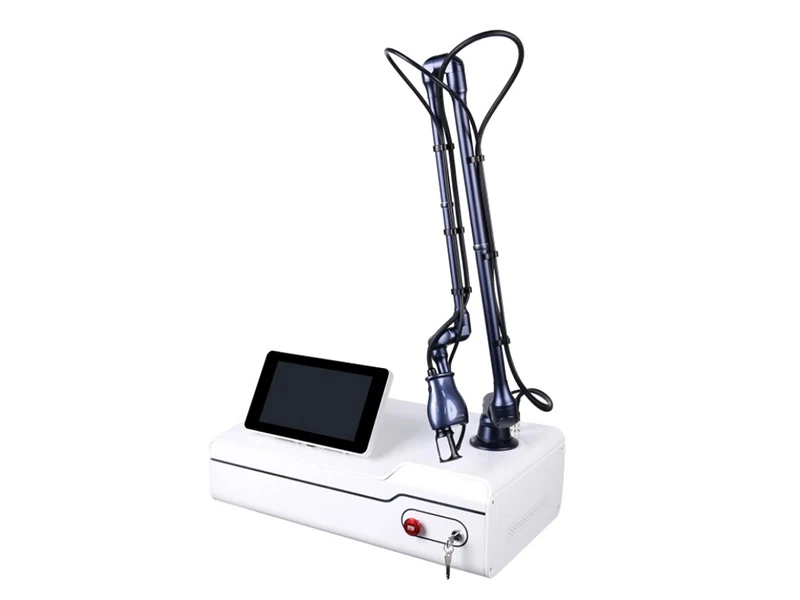
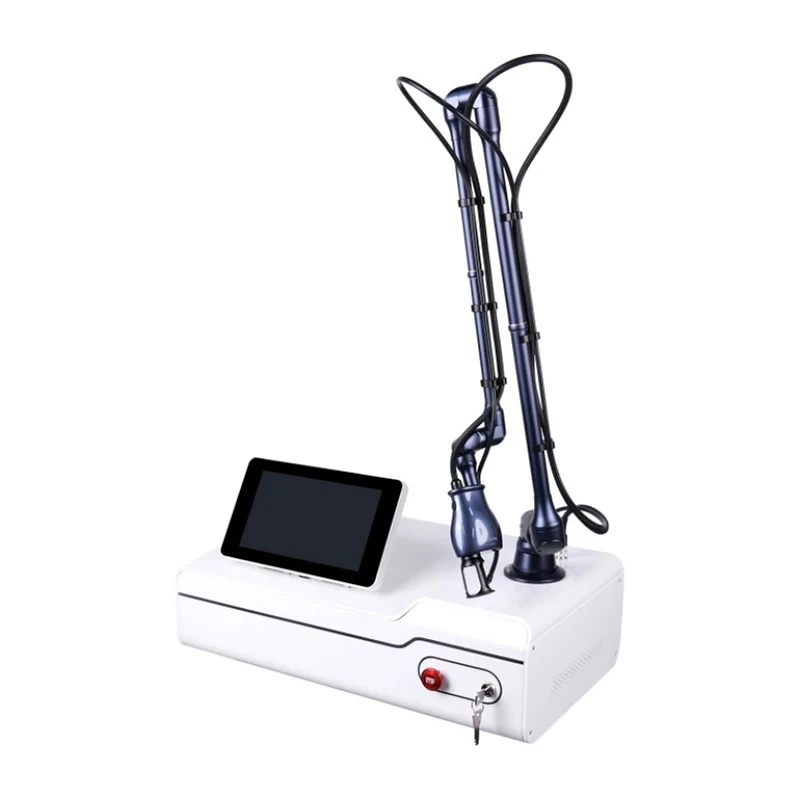
From a business perspective, better energy stability and longer service life can reduce maintenance expenses while improving treatment consistency. A CO2 fractional laser machine built with an RF metal tube minimises treatment variability, reduces maintenance downtime, and extends the device’s service life to several years of heavy use. One such system is the Advanced Portable RF Fractional CO2 Laser Machine for Skin Resurfacing & Vaginal Tightening, which integrates a premium 1-60W RF metal tube in a compact, portable body (Metal and ABS housing, gross weight 43 kg). Its intuitive 10.1-inch colour touch screen allows practitioners to finely tune scanning areas from a micro 0.1×0.1 mm up to 20×20 mm, enabling tailored ablation density and depth for conditions ranging from superficial pigmentation to deep burn scars.
Clinical Indications: Combining Skin Resurfacing and Gynecological Care
The dual capabilities of modern RF fractional systems extend clinical indications well beyond traditional dermatology, making them a versatile platform for combined aesthetic and gynecological services.
Skin and Scar Remodelling
In fractional and pulse output modes, controlled MTZs vaporise scar tissue and photodamaged skin layers. The thermal stimulus provokes immediate collagen contraction and a prolonged neocollagenetic response over the following months. As a result, clinicians commonly use it to treat atrophic acne scars, surgical scars, burn scars, and uneven skin texture. Superficial pigmented lesions such as solar lentigines, freckles, and melasma respond to precise epidermal ablation, while dermal heating tightens lax skin, reduces enlarged pores, and visibly softens rhytides. Because each treatment session leaves the majority of the skin surface intact, healing is accelerated, and the risk of post-inflammatory hyperpigmentation is reduced compared to fully ablative lasers.
Vaginal Health Management
Gynecological applications rely on a specialised 360-degree vaginal probe that emits thermal energy to the mucosa and submucosal layers. The controlled heating triggers immediate collagen fibre contraction and subsequent reorganisation of the connective tissue. In this mode, the system functions as a non-surgical vaginal tightening machine. Clinically, it has been used to improve vaginal laxity, enhance constriction, and provide long-lasting structural firmness. Additional benefits reported include increased natural lubrication, improved mucosal texture, and a more balanced internal pH environment.
Sourcing Considerations: Choosing a Qualified CO2 Fractional Laser Machine Factory
The quality and reliability of your device are determined long before it arrives at your clinic. When evaluating a CO2 fractional laser machine factory, look for demonstrated expertise in RF source integration, access to genuine OEM components, and robust international after-sales support. A direct partnership with a qualified factory can lower procurement costs, ensure custom configuration—such as specific handpieces or software language—and guarantee a steady supply of consumables.
A manufacturer like JingBow, which operates its own R&D and production facilities, can provide these advantages. With a focus on high-end RF metal tube technology, strict quality control processes, and the capability to integrate complementary systems, JingBow exemplifies what to expect from a reliable supplier. They offer the Advanced Portable RF Fractional CO2 Laser system complete with forced-air cooling, a long-life RF generator, and a 10.1-inch precision touch interface, all backed by technical training and warranty support.
Expanding Your Aesthetic Portfolio with Complementary Technologies
A single device, no matter how versatile, cannot cover every patient request. A well-rounded clinic pairs a deep-ablative fractional system with high-throughput, patient-pleasing solutions for hair reduction, body contouring, and skin rejuvenation.
Hair removal remains the most frequently requested non-invasive procedure worldwide. Adding a diode laser hair removal machine allows clinics to offer fast, comfortable, and effective treatments for all skin types. For instance, JingBow’s Professional 1200W 808nm Diode Laser Hair Removal Machine utilises a high-power diode bar with sapphire contact cooling, delivering consistent fluence with pulse widths that accommodate coarse terminal hair as well as finer vellus hairs. When paired with the fractional CO₂ platform for skin renewal and a HI-EMT & RF muscle-building system for body sculpting, the clinic establishes a complete face-intimate-body treatment matrix that maximises revenue per patient visit.
Technical Specifications: Advanced Portable RF Fractional CO2 Laser
| Specification | Details |
| Laser Type | RF-Excited Metal Tube CO2 Laser |
| Laser Wavelength | 10.6μm (10,600nm) |
| Laser Power | 1 – 60 W |
| RF Frequency | 1 MHz |
| Output Modes | Pulse / Single pulse / Continuous |
| Max Scanning Area | 20 × 20 mm |
| Min Scanning Area | 0.1 × 0.1 mm |
| Display Screen | 10.1-inch colour touch screen |
| Cooling System | Forced air cooling |
| Aiming Light | Red semiconductor indicator (650nm) |
| Shell Material | Metal + ABS |
| Supply Voltage | 110V – 230V |
| Machine Dimensions | 616 × 342 × 175 mm |
| Gross Weight | 43 kg |
FAQ
How does a fractional CO2 laser machine minimise downtime compared to traditional CO2 lasers?
It creates an array of microscopic treatment zones separated by untreated skin bridges. These intact bridges supply keratinocytes and fibroblasts that accelerate re-epithelialisation, typically reducing visible healing to a few days instead of weeks.
Is RF metal tube technology worth the higher initial investment over a glass tube?
For clinics with moderate to high patient flow, the answer is yes. The extended lifespan and consistent energy output reduce the frequency of costly tube replacements and minimise treatment variability, leading to more predictable results and a lower lifetime cost.
Can the same platform function as a vaginal tightening machine, and is it safe?
When fitted with the dedicated 360° probe, the equipment delivers controlled thermal energy to the vaginal mucosa. The procedure is non-surgical, and the fractional approach helps preserve healthy tissue. Proper training and adherence to treatment protocols are essential for safety.
What should I check when visiting a CO2 fractional laser machine factory?
Verify that the facility integrates authentic RF metal tubes, ask about the laser laser beam profile testing used for quality assurance, and confirm the availability of clinical training materials and remote technical support.
Is it possible to build a full body rejuvenation centre around these devices?
Yes. Many clinics combine a fractional CO2 laser for skin and scars, a diode laser hair removal machine for permanent hair reduction, and an electromagnetic muscle sculpting platform to create a comprehensive, non-invasive treatment menu under one roof.
Conclusion
Choosing the most suitable CO2 fractional laser machine requires looking past surface-level marketing claims and evaluating the core excitation technology. The evidence points clearly toward RF-excited metal tubes: they offer longer life, higher energy consistency, and a safer, more uniform beam profile than legacy glass tubes. Pairing the platform with complementary technologies such as a diode laser platform and a dedicated vaginal tightening function expands a clinic’s therapeutic reach. Ultimately, the foundation of long-term reliability lies in partnering with a transparent, engineering-focused factory that backs its technology with verifiable performance data. A landmark study by Manstein et al. first described fractional photothermolysis as a method to induce efficient cutaneous remodelling while leaving the stratum corneum largely intact (Manstein D, et al. “Fractional photothermolysis: a new concept for cutaneous remodeling using microscopic patterns of thermal injury.” Lasers in Surgery and Medicine, 2004). That principle, now enhanced by RF metal tube engineering, continues to define the clinical potential of modern fractional CO₂ systems.