Introduction
A professional picosecond laser tattoo removal machine requires more than high power. This guide explains how 2000W picosecond laser technology works, why ultra-short pulses and multiple wavelengths matter, and what buyers should evaluate before investing in laser equipment.
What is the Working Principle of the 2000W Picosecond Laser Tattoo Removal Device?
1. Working Principle of the 2000W Picosecond Laser Tattoo Removal Device
The 2000W picosecond laser tattoo removal device uses ultra-short laser pulses to interact with pigment particles. This photomechanical effect can break tattoo ink and unwanted pigments into smaller particles, allowing for more precise treatment. Here, “2000W” refers to the device’s total power capacity, not the energy delivered by a single pulse. The power capacity supports laser output, continuous operation, and multiple parameter settings.
Compared with traditional nanosecond lasers, picosecond lasers use shorter pulses to deliver energy to target pigments in an extremely short time. After absorbing the laser energy, pigment particles can break into smaller fragments. These fragments are then gradually cleared through the body’s natural metabolic processes.
The key advantage of picosecond lasers is not simply higher power. It also comes from the way the laser interacts with pigment. Traditional lasers primarily rely on the photothermal effect, using heat to break down target pigments. Picosecond lasers work differently.
2. How the 2000 W Power Platform and Ultra-Short Pulse Technology Enhance Pigment Treatment Efficiency
When tattoo ink enters the skin, it forms pigment particles of different sizes and at different depths. This can affect how difficult the tattoo is to remove. Larger particles are generally more resistant to natural clearance, so laser treatment may be needed to break them down further. Picosecond technology uses an extremely short pulse duration to deliver energy rapidly, which can improve pigment fragmentation.
During treatment, The 2000W power configuration helps maintain stable operation.. It allows the device to work with different treatment parameters for professional applications. However, treatment results depend on several factors, including single-pulse energy, pulse width, repetition rate, and spot size. The overall configuration therefore matters more than power alone. By adjusting these parameters, operators can tailor treatment to different pigment types and treatment areas. This helps balance treatment efficiency with precise control.
3. How Different Wavelengths Affect the Treatment Range of a 2000 W Picosecond Laser System
Laser wavelength affects how different pigments absorb laser energy. It also influences how deeply the laser can penetrate the skin. A 2000W picosecond laser system with multiple wavelengths can therefore offer greater treatment flexibility. Operators can select a suitable wavelength for the pigment being treated instead of relying on a single wavelength for every application.
For example, longer wavelengths generally penetrate deeper into the skin. They may therefore be more suitable for pigments located in deeper layers or for darker pigments. Shorter wavelengths, by contrast, are often absorbed more effectively by certain lighter-colored pigments. Because tattoo ink may contain black, blue, green, red, or mixed pigments, a single wavelength may not meet every treatment need.
Multi-wavelength technology can therefore expand the range of treatment applications. In clinical use, the 1064 nm wavelength typically provides deeper penetration. It is commonly used for black or blue tattoo pigments and other deeper pigmentation. The 532 nm wavelength, by contrast, is often used for lighter-colored tattoo pigments, such as red and orange. Additional wavelengths can further broaden the range of applications for specialized pigments and skin treatments.
How Does an Infinite-Shot Firing Design Enhance the Long-Term Operational Value of Laser Equipment?
1. Reduce Emission-Related Lifespan Iimitations and Enhance Daily Operational Efficiency
Laser equipment is often used frequently in professional beauty clinics. As a result, the service life and stability of the laser source are important for smooth daily operations. With some traditional equipment, components may need to be replaced after a specified number of shots. This can increase maintenance costs and may lead to downtime.
2. Reduce Long-Term Operating Costs and Improve Return on Investment (ROI)
The purchase price is only one part of the total cost of laser equipment. Maintenance, spare parts, and unexpected downtime can also affect long-term operating costs and the overall return on investment for beauty clinics.
An unlimited shot design can reduce the need for component replacement linked to a fixed shot count and help improve equipment availability. As a result, beauty clinics can make fuller use of the equipment throughout its service life while limiting potential additional operating costs.
3. Supports High-Frequency Therapy, Enhancing Equipment Flexibility
For cosmetic clinics with high treatment volumes, equipment must support frequent and continuous use. An unlimited shot design removes the need to track a fixed number of shots or firing cycles, giving clinics greater flexibility when scheduling high-frequency treatments.
4. Clinics Should not Focus Solely on the Number of Transmissions; instead, the Overall Performance Should be Comprehensively Evaluated.
Unlimited-shot capability is only one factor to consider when evaluating professional laser equipment. During procurement, clinics should also assess laser output stability, energy control, cooling performance, maintenance requirements, and treatment suitability.
From a practical standpoint, the value of an unlimited shot design lies in reducing shot-count limitations, improving equipment availability, and easing potential maintenance burdens. An appropriate device should balance these benefits with overall performance and long-term operating needs.
Why Choose the Jingbow Unlimited-Shot 2000W Picosecond Laser System?
When selecting professional laser equipment, cosmetic clinics should look beyond individual technical specifications. The equipment should be evaluated as a complete solution that meets the clinic’s treatment, operational, and long-term needs. Treatment capability, operational stability, flexibility, maintenance requirements, and long-term value all influence the actual return on investment.
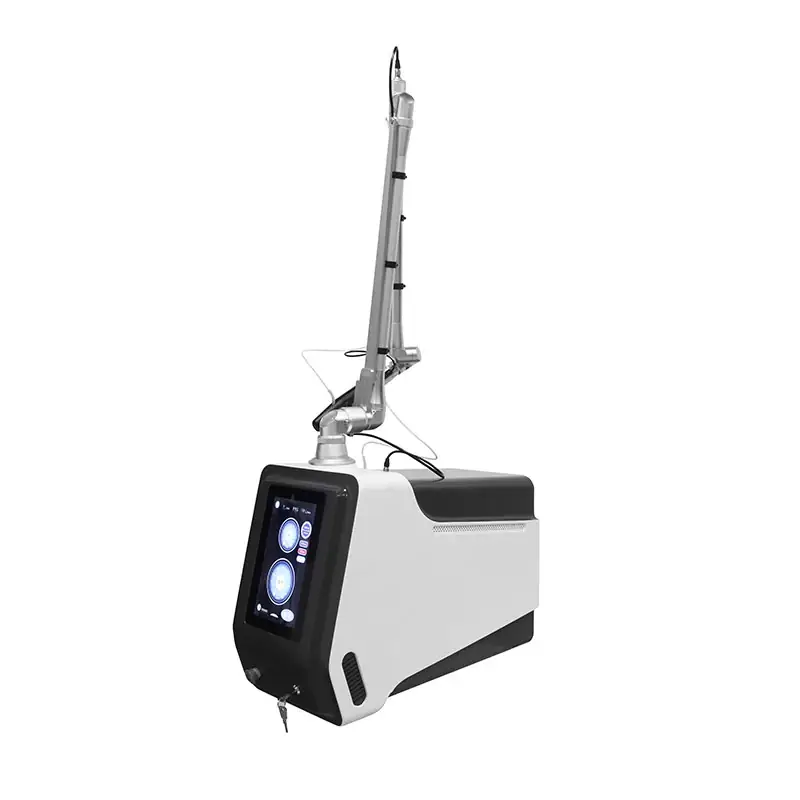
1. High Power Output and Flexible Parameter Adjustment
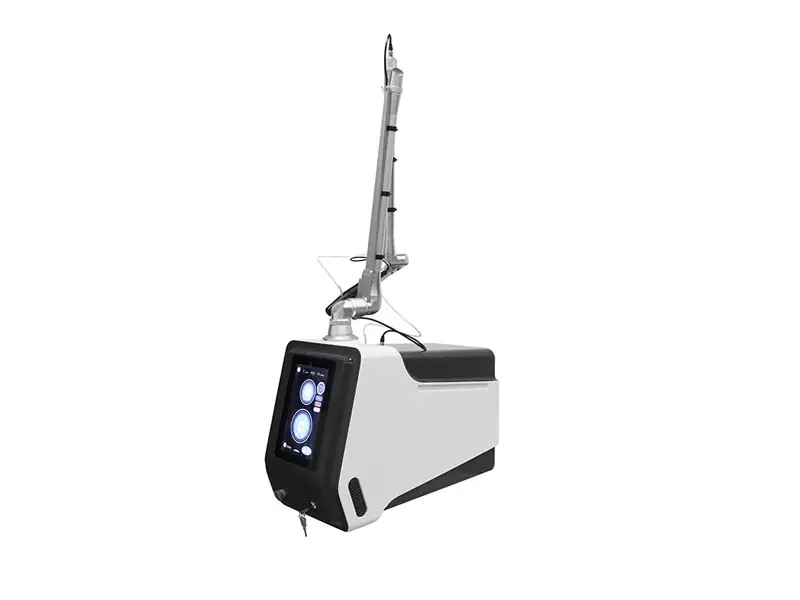
The Jingbow Medical 2000W picosecond laser tattoo removal device is designed for the long-term needs of professional aesthetic clinics. It combines high energy output, flexible treatment parameters, and stable operation. A 360° optical guide arm further improves operational flexibility compared with traditional cable-based handles.
This allows operators to adjust the treatment angle more easily for different tattoo areas and pigmentation treatment needs while maintaining stable laser energy delivery. The device also uses an infrared aiming beam imported from South Korea to help locate the treatment area precisely. For tattoo removal and pigmentation treatment, accurate positioning helps control the treatment field and the area targeted by the laser energy.
For continuous operation, the equipment uses dual air and water cooling. It also supports real-time monitoring of water temperature and flow rate. These features help maintain stable operation and reduce the risk of cooling-related abnormalities during high-frequency treatment.
The main technical specifications are as follows:
| technical parameter | specifications |
| Laser type | Nd: YAG laser |
| pulse length | 2000ps |
| standard wave length | 532nm / 1064nm |
| Optional wavelength | 755nm / 785nm / 1320nm |
| Maximum energy | 2.0J(2000mJ) |
| power | 2000W |
| service frequency | 1–10 Hz adjustable |
| spot size | 2–10 mm adjustable |
| display screen | 10.1-inch capacitive touchscreen |
| coolant passage | Air cooling + Water cooling |
| Aiming beam | South Korean imported infrared targeting beam |
| Pulse Mode | Single-pulse / Double-pulse |
| Security Monitoring | Water temperature and water flow rate monitoring |
| voltage | 110V / 220V – Customizable |
| Number of transmissions | Infinite firing |
2. Infinite Firing Cycles – Reduces Long-Term Usage Limitations
For cosmetic clinics that regularly perform tattoo removal and pigmentation treatments, the number of shots can be an important consideration over the life of the equipment. An unlimited shot design reduces limitations related to a fixed shot count and can make the device better suited to continuous, high-frequency treatment.
3. Multiple Wavelengths and Adjustable Light Spots – Tailored to Meet Diverse Therapeutic Requirements
The device offers standard wavelengths of 532 nm and 1064 nm. It also supports optional wavelengths of 755 nm, 785 nm, and 1320 nm. This multi-wavelength configuration provides additional flexibility for different pigments and treatment needs.
The 2–10 mm adjustable spot size also allows operators to adapt the treatment area. Smaller spots are more suitable for areas that require precise control, while larger spots can improve coverage efficiency over larger treatment areas. By adjusting the wavelength, spot size, repetition rate, and pulse mode, operators can set parameters according to specific treatment requirements.
4. Stable Cooling and Safety Monitoring – Supports Continuous Operation
In high-frequency treatment environments, cooling and operational monitoring are both important. The Jingbow Medical 2000W picosecond laser system uses air and water cooling while monitoring water temperature and flow rate in real time. Operators can therefore check the cooling status during use, which supports more stable continuous operation.
The value of the Jingbow Medical 2000W picosecond laser system goes beyond its 2000W power rating. Key features include a 2000W power supply, maximum energy output of 2.0 J, unlimited shot capability, and multiple wavelength options. An adjustable spot size, a 360° optical guide arm, dual cooling, and safety monitoring further support flexible and stable operation.
For professional aesthetic clinics, these features can be evaluated in terms of long-term operating efficiency, treatment flexibility, and operational stability.
Application Scope of 2000 W Picosecond Laser Equipment
The application range of picosecond laser systems depends mainly on wavelength configuration, energy output, and parameter flexibility. Different tattoo inks, pigmentation types, and pigment depths can absorb laser energy differently. A single wavelength may therefore not be suitable for every treatment scenario, which can limit practical applications.
This 2000W desktop picosecond laser tattoo removal device uses Nd:YAG laser technology. Its standard configuration includes 532 nm and 1064 nm wavelengths. Optional wavelengths of 755 nm, 785 nm, and 1320 nm can further expand its treatment range. With multiple wavelength options, operators can select a suitable treatment approach for different pigment types. The device can therefore be used for tattoo removal, pigmentation treatments, and various cosmetic applications, which can improve overall equipment utilization in professional medical and aesthetic settings.
1. Tattoo Removal: Requirements for Treating Dark and Colored Tattoos
Tattoo removal is one of the primary application areas for picosecond laser systems. A multi-wavelength configuration provides greater treatment flexibility. Operators can choose a suitable wavelength for different pigment types. The same platform can therefore support tattoo removal as well as other pigmentation and cosmetic applications.
The dual-wavelength combination of 1064 nm and 532 nm can address many common tattoo colors. The 1064 nm wavelength provides deeper penetration and is typically used for dark tattoos, such as black or blue. The 532 nm wavelength is more commonly used for lighter-colored tattoo pigments, including red and orange.
The 532 nm wavelength is generally more effective for lighter-colored tattoo pigments, such as red and orange. It can be useful for colored tattoos, especially when a single-wavelength system may provide limited coverage. By switching between wavelengths, operators can select suitable parameters based on tattoo color, depth, and pigment composition.
The system also supports single-pulse and double-pulse modes. With a repetition rate of 1–10 Hz and an adjustable spot size of 2–10 mm, operators can fine-tune parameters for different treatment areas. Larger spots can improve efficiency for larger tattoo areas, while smaller spots can provide more precise control in small or delicate areas.
2. Skin Pigmentation Therapy: Expanding the Scope of Device Applications
In addition to tattoo removal, picosecond laser technology is used for various skin pigmentation concerns, including freckles, sunspots, age spots, melasma, and nevus of Ota.
Pigmentation can vary in both cause and depth. The appropriate wavelength and energy settings should therefore be selected according to the characteristics of the pigmentation being treated. Epidermal pigmentation often requires precise energy control to limit unnecessary effects on surrounding tissue. Dermal pigmentation is located deeper in the skin, so wavelengths with greater penetration may be more appropriate.
With multiple wavelengths, operators can tailor treatment protocols to different pigment types. The combination of 532 nm and 1064 nm wavelengths covers many common pigmentation treatment needs. Picosecond technology delivers laser energy within an extremely short pulse duration. The rapid energy release can create a mechanical effect on target pigment particles, causing them to break into smaller fragments.
3. Management of Refractory Pigmentation and Complex Tattoos: Enhancing Treatment Flexibility
Certain tattoo colors and pigmentation conditions can place greater demands on laser equipment because of differences in hue, absorption, and depth. Complex colors such as green or cyan may be more difficult to address with a single wavelength.
For these applications, extended wavelengths such as 755 nm and 785 nm can provide additional options. Different wavelengths have different pigment absorption characteristics, which can improve flexibility when treating specialized tattoo colors and complex pigmentation issues.
For professional beauty clinics, a multi-wavelength system offers more than treatment versatility. It can also reduce the need for fixed equipment deployment, giving clinics greater flexibility in how the equipment is used. A wider range of treatment options can help clinics serve more client needs without purchasing separate equipment for every procedure.
4. Laser Powder Skin Renewal: Expanding Applications in Beauty Treatments
Some systems also offer an optional 1320 nm wavelength for applications beyond pigment removal. It can be used for cosmetic procedures such as laser carbon peeling and skin rejuvenation.
The 1320 nm wavelength has different applications from traditional pigment treatments. It is mainly used for skin care procedures, including skin conditioning, pore cleansing, and overall skin improvement. For clinics looking to expand their beauty services, this broader range of applications can increase the ways the equipment is used.
With multiple wavelength options, a picosecond laser system can support a wider range of aesthetic applications. These may include tattoo removal, pigmentation treatments, and various skin care procedures. The result is a more versatile platform rather than a device limited to a single application.
Frequently Asked Questions
Q1. What Is the Difference Between a Picosecond Laser and Traditional Tattoo Removal Lasers?
Picosecond lasers deliver energy through extremely short pulses and make greater use of the photomechanical effect to break pigment particles into smaller fragments. Compared with traditional nanosecond laser systems, picosecond technology delivers energy over a shorter time frame, which can change how energy interacts with the target pigment.
Q2. Why Is a 2000 ps Pulse Width Important for Tattoo Removal?
A 2000 ps pulse width releases laser energy within an extremely short time. This can enhance the mechanical disruption of target pigments while helping limit unnecessary heat accumulation in surrounding tissue.
Q3. What Are the Advantages of a Picosecond Laser System with Unlimited Shots?
An unlimited firing design removes the limitation of a fixed shot count. For beauty clinics with high equipment utilization, this can reduce potential replacement costs related to shot limits and support long-term equipment use.
Q4. How Many Treatment Sessions Are Needed to Completely Remove a Tattoo?
The number of treatment sessions depends on factors such as tattoo color, pigment depth, ink type, skin condition, and treatment parameters. A professional assessment is therefore needed for each individual case.
Conclusion
When selecting professional picosecond laser tattoo removal equipment, buyers should not merely compare the price or maximum power of the devices. It is more useful to consider technical capabilities, operational stability, application scope, and lifecycle cost.
This 2000W desktop picosecond laser system combines 2000 ps ultra-short-pulse technology, a maximum energy output of 2.0 J, multi-wavelength treatment capability, unlimited shot capability, and an intelligent cooling protection system. It provides professional beauty clinics with an integrated solution for tattoo removal and pigmentation treatment.
For businesses planning to procure laser equipment, valuable equipment should not only meet current treatment requirements. It should also maintain stable performance over the long term and support business growth.
For detailed technical specifications, equipment configuration recommendations, or professional selection advice, please contact us to obtain product documentation and technical support.